Hume Band 2.0 Review: Battery, Blood Pressure Trends and Who It's Really For
We may earn a commission if you buy through links on this page, at no extra cost to you. Learn more.

How we wrote this: our own long-term test of the Hume Band 2.0 is still in progress. This review brings together Hume's official specifications and the findings of independent reviewers (linked in the sources). We will add our own measurements when testing is complete.
The short answer
- Best for: people who want simple, screen-free sleep, recovery and long-term wellness trends without a mandatory monthly fee.
- Skip it if: you train seriously and want accurate workout data, or you already own the original Hume Band.
- Watch out for: battery life that may land closer to a week than the claimed 14 days, and blood pressure "insights" that are estimates, not readings.
The Hume Band 2.0 is a screenless wrist tracker from Hume Health that sells itself as "the wearable for living longer." Instead of chasing workout stats, it focuses on sleep, recovery, heart rate variability and longevity-style scores such as Biological Age and Metabolic Capacity. The big question is whether those insights are useful enough, and accurate enough, to justify the price. Here's what you need to know before you buy.
Check Hume Band 2.0 priceWhat the Hume Band 2.0 tracks
There's no display on the band itself. Everything you see lives in the Hume Health app (iPhone 8 or newer on iOS 14+, or Android 8.0+). According to Hume, the Band 2.0 tracks:
- Heart and recovery: heart rate, heart rate variability (HRV), blood oxygen (SpO2), skin temperature, recovery and strain.
- Sleep: sleep stages (light, deep, REM, awake), sleep quality and efficiency.
- Activity: steps, movement and active minutes.
- Longevity scores: Biological Age, Pace of Aging, Metabolic Capacity and Metabolic Momentum.
- Cardiovascular insights: estimated blood pressure trends, new in this generation.
Data can sync to Apple Health and Google Health Connect, so it plays nicely with other apps you might already use.
What's new compared with the original Hume Band
The 2.0 is an evolution rather than a reinvention. The main upgrades Hume lists are:
- Longer battery: up to 14 days claimed, compared with roughly 5–7 days for the first band.
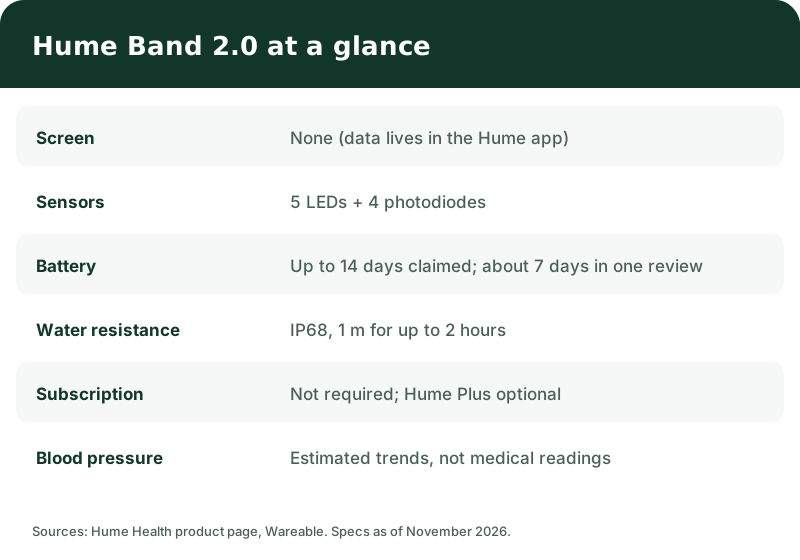
- New sensor array: 5 LEDs and 4 photodiodes, with what Hume calls improved signal processing.
- Cardiovascular insights: blood pressure trend estimates, which the first band didn't offer.
- Softer strap: a redesigned, knit-style strap for all-day comfort.
Wareable's reviewer concluded that there are few new features beyond these, and advised first-generation owners to skip the upgrade.
Battery life: 14 days on paper, about a week in practice
Battery life is the headline upgrade, but real-world results vary. Wareable's main reviewer wore the band day and night and needed to charge after about seven days. In a separate comparison test, one unit lasted well over two weeks while another needed a charge after roughly a week. Hume itself notes that frequent syncing and continuous tracking can reduce battery life.
Charging is quick: Hume quotes 20 to 80 minutes depending on how low the battery is. Even at a week per charge, the Band 2.0 lasts noticeably longer than most smartwatches.
Blood pressure trends: useful context, not a cuff replacement
The most talked-about new feature is blood pressure tracking, and it's important to understand what it is. The band uses pulse data to estimate how your blood pressure may be trending over time. Hume describes its cardiovascular insights as "not a medical device or a diagnosis" but a trend layer. Hume's product page does not claim FDA clearance for this feature.
In other words, treat it as a nudge, not a number to act on. If you need to monitor blood pressure, use a validated upper-arm cuff and talk to your doctor.
Accuracy: the biggest question mark
Hume says its tracking is validated in lab studies and third-party testing, but its product page doesn't link to those studies. Independent testing has been less flattering: Wareable's reviewer reported inaccuracies in heart rate, sleep and recovery data, and testers saw inconsistent step counts and workout durations. The app also needs about a week of data before many insights appear.
For a wellness tracker focused on long-term trends, small day-to-day errors matter less than for a training device. But if precise numbers are important to you, this is the band's weakest point.
Comfort and design
Reviewers consistently praise the comfort. The soft strap is light enough to forget about after a few days, which matters for sleep tracking. Two caveats came up in testing: the strap could chafe during high-intensity workouts, and the clasp occasionally came undone, costing one tester a night of sleep data.
The band is rated IP68, which Hume defines as water-resistant to 1 meter for up to 2 hours. Showering and casual swimming are fine.
Price and subscription
This is where the Hume Band 2.0 stands out from rivals like WHOOP and Oura. You buy the band once and the core app is free. Hume says no subscription is required to use the band or access your raw data. An optional Hume Plus plan adds AI coaching and weekly reports.
Prices vary by retailer and Hume runs frequent sales, so check the current price before you buy. Hume offers a 45-day refund window and a 1-year warranty, with an optional 10-year warranty add-on.
What we like
- No mandatory subscription
- Comfortable, screen-free design for 24/7 wear
- Longer battery than the original band
- Simple, beginner-friendly insights
- 45-day money-back guarantee
What we don't
- Independent testers report accuracy issues
- Real-world battery can fall well short of 14 days
- Weak workout tracking for athletes
- Blood pressure feature is an estimate only
- Few reasons to upgrade from the first band
Hume Band 2.0 vs alternatives
| Hume Band 2.0 | WHOOP 5.0 | |
|---|---|---|
| Screen | None | None |
| Payment model | Buy once; optional plan | Membership required |
| Focus | Wellness and longevity trends | Training, strain and recovery |
| Workout analytics | Basic | Detailed |
For a deeper look, read our Hume Band 2.0 vs WHOOP 5.0 comparison. If body composition is your main goal, Hume's own Hume Pod 2.0 smart scale pairs with the band in the same app.
Our verdict (so far)
The Hume Band 2.0 makes sense if you want an easy, comfortable, screen-free way to watch your sleep and wellness trends without paying every month. It is not the tracker to choose for serious training or for precise health measurements, and its blood pressure feature should be read as a rough trend only. We'll update this verdict with our own test data.
Where to buy
The Hume Band 2.0 is sold directly by Hume Health and through authorized retailers. Buying direct gives you Hume's 45-day refund window. Prices change often, so compare before you order.
See current Hume Band 2.0 dealsFAQ
Does the Hume Band 2.0 need a subscription?
No. Hume says the band and its core metrics work without a subscription. An optional Hume Plus plan (listed from $8.99 per month) adds AI coaching and deeper reports.
How long does the Hume Band 2.0 battery last?
Hume claims up to 14 days per charge. Independent testers have reported mixed results: Wareable's reviewer got about 7 days, while another Wareable test unit lasted more than two weeks.
Can the Hume Band 2.0 measure blood pressure?
Not in the medical sense. It estimates blood pressure trends from pulse data. Hume describes its cardiovascular insights as a trend layer, not a medical device or diagnosis. Use a validated cuff for actual readings.
Is the Hume Band 2.0 waterproof?
It is rated IP68: dustproof and water-resistant to 1 meter for up to 2 hours, so showering and casual swimming are fine. Hume does not position it for intense water sports.
Is the Hume Band 2.0 good for workouts?
It tracks steps, activity, strain and recovery, but independent reviewers found workout detection and step counts inconsistent. Runners and athletes who want training analytics are better served by a Garmin, WHOOP or similar device.