Hume Pod 2.0 Review: Is This 3D Body Composition Scale Worth It?
We may earn a commission if you buy through links on this page, at no extra cost to you. Learn more.

How we wrote this: we haven't finished our own testing of the Hume Pod 2.0 yet. This review is based on Hume's specifications, published research on the original Pod and independent coverage (see sources). We'll add our own repeat-weigh-in and comparison data when it's ready.
The short answer
- Best for: people tracking fat loss, muscle gain or healthy aging who want far more than weight and BMI, including arm, leg and trunk breakdowns.
- Standout: 45 metrics, 8-frequency hand-and-foot BIA, and a free app with no required subscription.
- Keep in mind: the headline "99% accurate vs DEXA" claim isn't backed by a published study for the 2.0, and all home scales estimate body composition.
The Hume Pod 2.0 (also sold as the Hume Body Pod 2.0) is Hume Health's second-generation body composition scale. Like many premium smart scales, it has a handle you hold while you stand on it, so it can measure your upper and lower body separately. Hume adds a heart rate sensor, a 3D body map it calls a "digital twin" and AI-powered insights that connect your scans with data from the Hume Band 2.0.
Check Hume Pod 2.0 priceKey specs
| Measurement | 8-frequency bioelectrical impedance analysis (BIA) |
| Electrodes | 8 hand and foot sensors for segmental analysis, plus 4 weight sensors |
| Metrics | 45 (20 core, 20 segmental, 5 scores) |
| Extras | Heart rate sensor, 2.8-inch display, 3D body map |
| Platform | Tempered glass, 12.7 × 12.7 × 1.1 in |
| Weight range | 11 to 441 lbs |
| Users | Multiple accounts; connects to up to 24 devices |
| Battery | Rechargeable, up to 1 year per charge (claimed) |
| Colors | Black or white |
What the Hume Pod 2.0 measures
Most budget smart scales send a small current through your feet only, so they guess what's happening in your upper body. The Pod 2.0 uses a handle with electrodes as well as foot pads, which lets it estimate each arm, each leg and your trunk separately. Hume groups its 45 metrics like this:
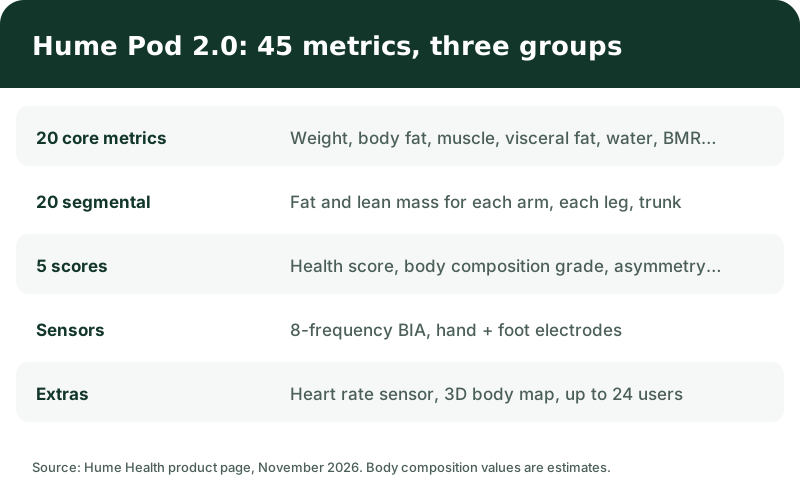
- Core metrics: weight, BMI, body fat, fat mass, muscle mass, skeletal muscle mass, visceral fat, metabolic age, BMR, hydration and body water (including intracellular and extracellular water), protein, bone mineral content and heart health.
- Segmental metrics: fat and lean mass for your right and left arms, trunk, and right and left legs.
- Scores: an overall health score, body composition grade, activity and sleep grades, and a left-right asymmetry flag.
The segmental data is the most useful part for many people. It can show whether training is building muscle evenly, or whether you're losing fat while holding on to muscle during a diet.
Accuracy: what the evidence actually says
Hume's marketing claims "99% body-fat accuracy compared with DEXA," based on a study by a company called Socotech. Hume's page doesn't link to that study or give its sample size or method, so we can't evaluate it.
There is better evidence for the original Hume Pod. According to Hume, researchers at Texas Tech University compared it with a laboratory four-compartment model, considered a gold-standard reference. Hume reports that the Pod's body-fat readings averaged 0.6 percentage points higher than the lab method, that it beat 14 other home scales the same lab had tested, and that repeat readings ten minutes apart moved by less than one point. Hume says it did not fund the study or supply the device.
Two important caveats:
- Those results are for the first-generation Pod. Independent data for the 2.0 hasn't been published yet.
- Research on consumer BIA devices in general shows they are not equivalent to lab methods for individuals. A recent systematic review of 12 studies found average body-fat differences between BIA and a four-compartment model ranging from −3.5 to +4.4 percentage points across studies.
The practical takeaway: weigh in at the same time of day, in similar conditions, and focus on the trend over weeks rather than any single reading.
The Hume app and subscription
Weigh-ins and body composition data are free. Hume Plus, listed at $9.99 per month, adds coaching, deeper reports and personalized programs. If you also wear the Hume Band 2.0, the app combines your scans with sleep, activity and recovery data in one place.
Safety notes
Hume states the Pod is safe for people with pacemakers or ICDs implanted after 1992. Many other scale makers advise anyone with an implanted electronic device not to use bioimpedance, so please check with your cardiologist before using it. Hume's product page doesn't address pregnancy; if you're pregnant, ask your doctor before using any body composition scale.
What we like
- Segmental arm, leg and trunk analysis
- 45 metrics, including visceral fat and body water
- Free app; no subscription required
- Up to a year per charge (claimed)
- HSA/FSA eligible, with a 45-day return window
What we don't
- Headline DEXA accuracy claim isn't published in detail
- No independent accuracy data for the 2.0 yet
- Only one phone can connect at a time
- Premium coaching costs extra
Hume Pod 2.0 vs a cheaper alternative
RunStar's 8-electrode scales also use a handle for segmental readings and often sell for less. We compare them in Hume Pod 2.0 vs RunStar, and cover the full lineup in our RunStar smart scale guide.
Our verdict (so far)
On paper, the Hume Pod 2.0 is one of the most complete home body composition scales you can buy: hand-and-foot BIA, 45 metrics, a long battery and a free app. Its marketing goes further than its published evidence, though, so buy it to track trends, not to replace a DEXA scan. We'll update this review with our own measurements.
Where to buy
The Hume Pod 2.0 is sold directly by Hume Health, which offers a 45-day refund window when you buy direct. Hume frequently runs sales, so check the current price.
See current Hume Pod 2.0 dealsFAQ
How accurate is the Hume Pod 2.0?
Hume advertises body-fat readings within about 2% of DEXA, citing a study it does not publish in detail. A university study of the original Hume Pod, which Hume says it did not fund, found its body-fat readings averaged 0.6 percentage points higher than a lab four-compartment model. Results for the 2.0 have not been independently published yet, and any home scale is best used for trends.
Does the Hume Pod 2.0 require a subscription?
No. Weigh-ins and body composition data are free in the Hume app. Hume Plus, listed at $9.99 per month, adds coaching and deeper reports.
How many people can use one Hume Pod 2.0?
Hume says one Pod supports multiple accounts and can connect to up to 24 devices, though only one phone can connect at a time.
Is the Hume Pod 2.0 safe with a pacemaker?
Hume states the Pod is safe for pacemakers and ICDs implanted after 1992. Many manufacturers advise people with implanted electronic devices not to use bioimpedance scales, so check with your cardiologist first.
What is the difference between Hume Pod 2.0 and Hume Body Pod?
Hume Pod 2.0 is the second-generation Body Pod. It adds a heart rate sensor, a 3D body map or digital twin, a new design in black or white, and deeper AI-powered insights in the Hume app.